
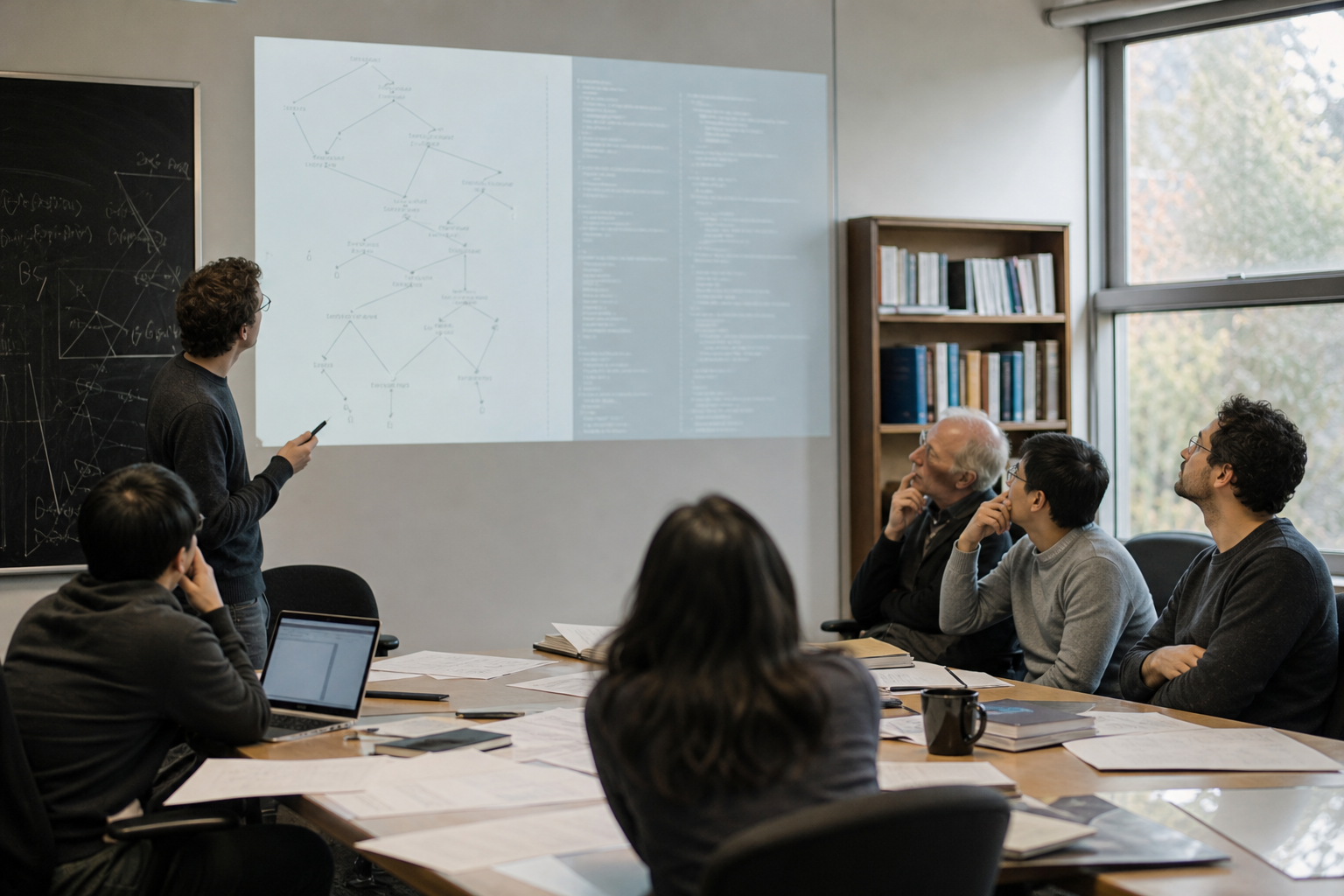
OpenAI model-produced math ETH Kakeya Yang–Mills claims explained
OpenAI model-produced math ETH Kakeya Yang–Mills claims: OpenAI model-produced math ETH Kakeya Yang–Mills claims announced Oct 26, 2026. OpenAI released manusc…
View article sections
- 01Understanding the OpenAI model-produced math ETH Kakeya Yang–Mills claims
- 02Why mathematicians and computer scientists are treating this cautiously
- 03Quick primer: ETH, Kakeya (local smoothing), and Yang–Mills
- 04Verification status and timeline
- 05Table: Claims, artifacts, and verification outlook
- 06What the announcement means for non-academic audiences and small businesses
- 07Risks, limitations, and why formal verification still matters
- 08Comparison with prior AI-assisted math events
- 09How academics will likely validate the artifacts
- 10Analysis: Why this episode matters for AI governance and research norms
- 11Practical next steps (who should do what)
- 12Sources and how we’re labeling them
- 13Bottom line (as of 2026-10-27)
- 14Further reading and monitoring
- 15FAQs
- 16Related guides and resources
- 17Frequently asked questions
- 18Need practical help?
OpenAI model-produced math ETH Kakeya Yang–Mills claims is the focus of this dated, source-based update. As a result, the article separates verified details from analysis.
What changed (Oct 26, 2026) and why it matters: On October 26, 2026 OpenAI published a research post and accompanying artifacts saying its models produced manuscripts and formalizations that amount to three major results: a claimed refutation of the Exponential Time Hypothesis (ETH), a claimed proof of the local smoothing conjecture with consequences for Kakeya-type problems, and claimed construction/existence results for certain quantum field theories (Yang–Mills/QCD). OpenAI released the material in an openai/math GitHub repository and said external academic “shepherds” will verify and explain the work. The announcement matters because, if verified, the results would touch core problems in theoretical computer science, harmonic analysis, and mathematical physics, and they raise questions about how model-generated mathematics is validated and communicated to the public.
Confirmed facts: OpenAI published a blog post describing the initiative and posted artifacts (including manuscripts and Lean formalizations) to a public GitHub repository on October 26, 2026 [1][2]. Independent reporting about the substance and broader context appeared the next day in outlets including TechCrunch [3].
Understanding the OpenAI model-produced math ETH Kakeya Yang–Mills claims
The phrase “OpenAI model-produced math ETH Kakeya Yang–Mills claims” refers to the three linked results OpenAI announced on October 26, 2026 and the fact that the supporting documents were generated or formalized with help from its models. The company made a public repository of manuscripts and Lean proof files and called for outside academic verification [1][2].
What exactly did OpenAI announce?
- ETH refutation claim: OpenAI posted a manuscript and formalization asserting a disproof or counterexample to the Exponential Time Hypothesis (ETH), a foundational conjecture in theoretical computer science about the time complexity of some NP-complete problems [2].
- Local smoothing / Kakeya claim: OpenAI released a proof that it says establishes the local smoothing conjecture, which has implications for the Kakeya and Fourier restriction conjectures in harmonic analysis [2].
- Yang–Mills / QFT claim: OpenAI supplied arguments and formal artifacts purporting to demonstrate existence results for certain quantum field theories, including constructions in the Yang–Mills family with connections to QCD [2].
Official announcement: OpenAI framed the materials as model-produced drafts and formal proofs and asked the academic community to act as “shepherds” and independent verifiers; the company did not declare the results as fully verified mathematical theorems as of its post [1].
Why mathematicians and computer scientists are treating this cautiously
Major conjectures like ETH, Kakeya, and Yang–Mills have long, deep histories and wide-reaching consequences. Verification of proofs — whether human-authored or machine-assisted — typically requires close peer review and time for the community to inspect, replicate, and debate the arguments. Formal proofs encoded in proof assistants like Lean can accelerate checking, but they are only part of the validation process.
As of October 27–28, 2026, academics and journal editors say they will examine the submitted Lean files and manuscripts and assess whether the formalizations are faithful, whether any unproven lemmas are used, and whether the claims genuinely settle the stated conjectures. Independent reporting has begun to explain both the technical claims and the sociotechnical implications [3].
How these claims were published and what artifacts are available
OpenAI posted a public GitHub repository titled openai/math containing manuscripts and Lean formalizations released on October 26, 2026 [2]. The company’s blog described the engagement plan with academic communities and signaled an intent to fund or coordinate external verification work, calling these items model-produced artifacts rather than final, community‑vetted theorems [1].
Quick primer: ETH, Kakeya (local smoothing), and Yang–Mills
- Exponential Time Hypothesis (ETH): A conjecture in theoretical computer science that certain NP-complete problems (like 3-SAT) require time exponential in the number of variables; a refutation would alter assumptions used in complexity theory and algorithm design.
- Kakeya and local smoothing: The Kakeya problem concerns sets that contain a unit line segment in every direction and has connections to how oscillatory integrals behave; the local smoothing conjecture is a related analytic statement with implications for the restriction conjecture and wave propagation estimates.
- Yang–Mills / QFT: Questions in mathematical physics about existence and properties of quantum field theories, notably those analogous to Yang–Mills theory which underpins the theory of the strong force (QCD) in particle physics.
These subjects are technical; verifying claims across them typically requires expertise from multiple subfields. Model-produced drafts can help by producing formal proof steps, but human validation remains essential.
Verification status and timeline
As of October 27–28, 2026: OpenAI has publicly posted artifacts and invited academic “shepherds”; independent reporting is ongoing; no community-wide verification or journal acceptance has been announced [1][2][3].
What to expect next: Verification will likely proceed in stages: initial sanity checks on the formal Lean files, scrutiny of any human-authored bridging lemmas, reproduction attempts by independent groups, and discussion in seminars and preprint commentary. If errors are found, authors may issue corrections or withdraw statements. If verification succeeds, the work will need to pass peer review for formal mathematical acceptance, which can take months or years.
Table: Claims, artifacts, and verification outlook
| Claim | Artifacts released | Verification status (as of 2026-10-27) | Potential implications |
|---|---|---|---|
| ETH refutation | Manuscript + Lean files | Under independent review; not yet accepted | Would change complexity lower bounds assumptions; affect cryptography and algorithms |
| Local smoothing / Kakeya | Manuscript + formalization | Under scrutiny; community commentary expected | Large impact on harmonic analysis and PDE theory if correct |
| Yang–Mills / QFT existence | Argument sketches + formal artifacts | Speculative until independent verification | Would be a major development in mathematical physics |
What the announcement means for non-academic audiences and small businesses
For most consumers and small businesses, the immediate effects are limited. There is no direct operational impact on IT systems, repair services, or typical software products. However, the episode matters as an early, high-profile case of model-generated research artifacts and affects trust, standards, and policy around AI-assisted scientific outputs.
Practical takeaways for small businesses, as of Oct 27, 2026:
- Evaluate claims skeptically: Treat extraordinary claims—especially those produced or assisted by models—with careful scrutiny before acting on them.
- Rely on proven standards: For business-critical workflows, continue to depend on vetted standards, documented processes, and human experts rather than model assertions alone.
- Monitor regulatory and industry guidance: Model-generated research may prompt new verification or labeling rules; stay informed through trusted industry publications.
Risks, limitations, and why formal verification still matters
Model-produced mathematics faces several challenges:
- Soundness: Large language models can produce plausible but incorrect arguments; formal proof checkers only help if the formalization faithfully encodes valid steps.
- Human oversight: Many proofs rely on informal intuition and unpublished lemmas; these require expert translation into formal language.
- Reproducibility: The broader community must reproduce and re-check results; a repository alone does not produce consensus.
OpenAI’s release includes Lean files designed to be machine-checkable, which reduces some risks but does not eliminate the need for human peer review and domain expert judgment [2].
Comparison with prior AI-assisted math events
Previous instances of AI-assisted math focused on conjecture exploration, automated lemma suggestion, or formalization of known proofs. What’s different here is the combination of three bold, foundational claims packaged with formal artifacts and a public call for academic shepherding. Independent news coverage places the announcement in the context of an accelerating trend of model-aided research [3].
How academics will likely validate the artifacts
- Run the Lean formalizations in isolated environments to reproduce machine checks.
- Audit the formalizations to ensure they match the informal manuscript claims and that no external unproven assumptions are hidden.
- Attempt independent reconstructions of key proof steps and test edge cases the proofs rely on.
- Discuss findings in seminars, preprint servers, and formal peer review outlets.
OpenAI’s invitation for academic shepherds anticipates this chain of verification, but the scope and timescale remain uncertain [1].
Analysis: Why this episode matters for AI governance and research norms
OpenAI’s publication of the materials opens important debates about transparency, responsibility, and the division of labor between models and human experts. On one hand, formal proof artifacts can accelerate discovery and reduce human toil. On the other, model-generated claims can be premature, misinterpreted, or weaponized if they are presented without sufficient caveats.
Independent reporting and commentary will be crucial to ensure the public and policymakers understand what has and has not been verified [3].
Practical next steps (who should do what)
- Mathematicians and theoretical CS: Inspect the Lean files, reproduce checks, and publish commentary. Attend seminars and coordinate with peers.
- Physicists: Assess the Yang–Mills artifacts for mathematical rigor and physical relevance; coordinate with mathematicians when proofs borrow deep analysis.
- Small businesses and IT managers: No immediate action. Stay informed, and if your operations depend on claims of algorithmic breakthrough, require peer-reviewed confirmation before operational changes.
- Journalists and policymakers: Treat the materials as a major announcement requiring independent expert interpretation; avoid amplifying unverified conclusions.
Sources and how we’re labeling them
- Official announcement: OpenAI blog post describing the initiative and the invitation to academic shepherds (published Oct 26, 2026) — labeled as an official announcement and primary source [1].
- Artifacts: openai/math GitHub repository with manuscripts and Lean formalizations (published Oct 26, 2026) — labeled as a primary artifact source [2].
- Independent reporting: TechCrunch coverage and analysis published Oct 27, 2026 — labeled as independent reporting summarizing and contextualizing the release [3].
Bottom line (as of 2026-10-27)
OpenAI’s publication of model-produced manuscripts and Lean formalizations claiming to refute ETH, resolve the local smoothing/Kakeya questions, and deliver Yang–Mills existence results is a major news event that demands careful verification. The phrase OpenAI model-produced math ETH Kakeya Yang–Mills claims captures both the content of the announcements and the novel provenance of the artifacts. Independent validation is in progress and will determine whether the claims reshape parts of complexity theory, harmonic analysis, and mathematical physics. For most businesses and consumers, the immediate practical consequences are limited; the episode is more important for research norms, verification standards, and AI governance.
Further reading and monitoring
Follow the openai/math GitHub repository for the released artifacts and updates (OpenAI’s repository was published Oct 26, 2026) [2]. Watch for academic preprints, seminar notes, and peer-review reports over the coming months. Independent tech reporting provides context and analysis as verification proceeds [3].
FAQs
Q: Are these claims verified?
A: No. As of Oct 27, 2026, the artifacts are public but the mathematical community has not completed independent verification; OpenAI asked academics to act as shepherds [1][2].
Q: Did OpenAI say the models proved these theorems on their own?
A: OpenAI presented the materials as model-produced manuscripts and formalizations but emphasized that external verification is required. The company did not claim community-wide validation at publication [1].
Q: Could these results change cryptography or software practices?
A: Potentially, if the ETH refutation is verified, it could alter theoretical lower bounds that underpin some algorithmic assumptions. However, such shifts require rigorous verification and subsequent analysis before any practical cryptographic changes would be recommended.
Q: How will formal proof files in Lean affect verification?
A: Lean files enable machine-checkable steps that can speed detection of syntactic or logical errors. But they must be audited to ensure the formalization accurately captures the intended mathematical claims and that no hidden assumptions remain.
Q: What should small businesses do about this announcement?
A: Nothing immediate. Maintain usual security and software best practices. Monitor verified outcomes if your products or services depend on specific algorithmic assumptions.


Frequently asked questions
Are the OpenAI model-produced math ETH Kakeya Yang–Mills claims already accepted by the mathematical community?
No. As of October 27, 2026 the claims and supporting artifacts have been published by OpenAI, but independent verification, community scrutiny, and peer review are still underway [1][2][3]. OpenAI described the files as model-produced drafts and invited academic shepherds to participate in validation [1].
What artifacts did OpenAI release to support the claims?
OpenAI published manuscripts and Lean formalization files in a public GitHub repository (openai/math) on October 26, 2026. The repository contains model-produced drafts and formal proof files intended to aid verification [2].
If ETH were refuted, what practical effects could follow?
A verified refutation of ETH could reshape theoretical complexity assumptions and influence algorithmic lower bounds. Practical cryptography or software engineering changes would require substantial follow-up research, verified proofs, and careful risk assessment before altering deployed systems.
How will researchers check whether the model-produced proofs are valid?
Researchers will run and audit the Lean files, translate any informal lemmas into formal statements, reproduce key steps independently, and discuss results in seminars and peer-reviewed outlets. Formal machine checks expedite some steps but do not replace expert review.
Should small businesses change anything because of these announcements?
No immediate changes are warranted for most small businesses. Continue relying on established standards and vetted expert advice. Monitor verification outcomes only if your operations depend on affected algorithmic assumptions.
Need practical help?
Fixit Solutions Inc. — Contact Fixit Solutions today to request a free estimate, schedule a repair or discuss your business technology needs. Service area: Lake Forest, CA.
Topic in context
Sources and further reading
These links were validated and checked when possible when this article was created; some publishers limit automated requests. Facts, guidance, prices, regulations, and availability can change.
- Working with academic communities to build scientific understanding — OpenAI (official blog) (2026-10-26) — primary source
- openai/math — repository of model-produced manuscripts and formalizations — GitHub / OpenAI (repository) (2026-10-26) — primary source
- Frontier AI labs say their models refuted the Exponential Time Hypothesis. What does that mean? — TechCrunch (2026-10-27)