
NVIDIA DLSS 5 launch September 3 2026: What Gamers Need
NVIDIA DLSS 5 launch September 3 2026: NVIDIA DLSS 5 launch September 3 2026: RTX 50-series exclusivity, NBA 2K27 rollout, benchmarks, and upgrade guidance for…
View article sections
- 01NVIDIA DLSS 5 launch September 3 2026 — what changed and why it matters
- 02NVIDIA DLSS 5 launch September 3 2026 — official details, confirmed facts, and reporting
- 03How DLSS 5 differs from earlier upscalers and competitors
- 04Support, exclusivity, and the controversy
- 05Performance, fidelity, and what early benchmarks do — and don’t — tell us
- 06Who should upgrade, who should wait, and practical next steps
- 07Risks, likely problems, and limitations
- 08Alternatives if you don’t have an RTX 50-series GPU
- 09Final verdict (as of 2026-09-01)
- 10FAQs
- 11Related guides and resources
- 12Frequently asked questions
- 13Need practical help?
- 14Topic in context
- 15Sources and further reading
NVIDIA DLSS 5 launch September 3 2026 — what changed and why it matters
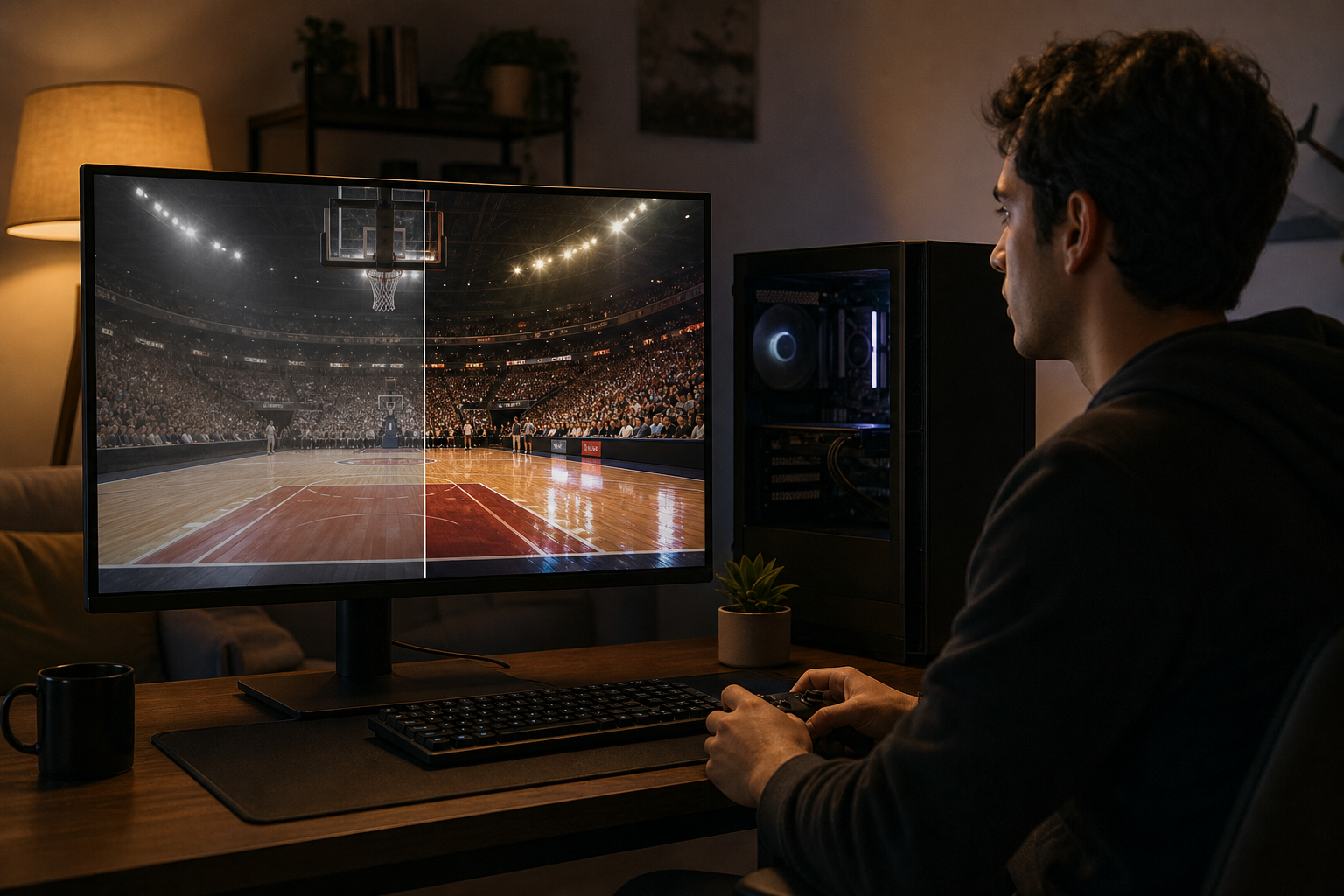
Confirmed: NVIDIA is rolling out DLSS 5 the week of September 3, 2026, with NBA 2K27 as the first shipping title to include the feature. This move matters because DLSS 5 is NVIDIA’s biggest leap in AI-guided rendering yet and could change visual fidelity expectations across modern PC gaming and cloud streaming [1][2][3].
Official announcement: NVIDIA first introduced the technology publicly in March 2026 as “3D-guided neural rendering,” describing a system that reconstructs complex lighting and geometry details using neural networks and scene-aware guidance [1]. Independent reporting confirms the formal launch timing and initial game partner details as of 2026-09-01 [2][3].
Quick summary (as of 2026-09-01)
- Launch date: Week of September 3, 2026 (officially rolling out starting Sept. 3) — confirmed by multiple reports [2][3].
- First shipping title: NBA 2K27 will be the first retail game to ship with DLSS 5 support [2][3].
- Official GPU support: NVIDIA states DLSS 5 will be available on RTX 50-series desktop GPUs, RTX 50-series laptops, and through GeForce Now — RTX 40 and older cards are not part of the official support list [2].
- Source categorization: NVIDIA’s technical overview is the official source for the technology description [1]; industry outlets provided launch timing and early benchmarks [2][3].
NVIDIA DLSS 5 launch September 3 2026 — official details, confirmed facts, and reporting
Official details: NVIDIA’s product announcement describes DLSS 5 as a 3D-guided neural rendering system that uses per-object and per-pixel guidance to reconstruct higher-fidelity frames from lower-cost inputs, targeting a step-change in realism over prior upscaling methods [1]. This is an official technical framing from NVIDIA’s March 2026 release and remains the baseline description as of this article [1].
Confirmed support and distribution: Multiple independent outlets report the technology will ship beginning the week of September 3, with NBA 2K27 as the first shipping game and availability extended across new RTX 50-series GPUs, compatible laptops, and NVIDIA’s GeForce Now cloud service [2][3]. Those are confirmed rollout details from company briefing and press reporting [2][3].
What’s officially confirmed vs. what’s still developing
- Confirmed: Launch timing, NBA 2K27 partnership, RTX 50-series official support, and GeForce Now inclusion [1][2][3].
- Official technical claim: DLSS 5 uses 3D-guided neural rendering to improve scene reconstruction and material accuracy, per NVIDIA’s technical materials [1].
- Independent reporting: Media outlets published early benchmarks and community reaction ahead of launch; those reports summarize company-provided numbers and some leak-driven tests [2].
- Estimates and uncertainty: Real-world performance impact, cross-game quality trade-offs, and how developer implementations will vary remain to be independently verified by broader third-party testing after launch (estimates only until more data is available).
How DLSS 5 differs from earlier upscalers and competitors
Context: Prior DLSS versions used frame- and motion-guided neural upscaling with temporal accumulation. NVIDIA describes DLSS 5 as adding explicit 3D guidance to the neural reconstruction process, which aims to better handle reflections, geometry edges, and complex lighting without the usual temporal blurring artifacts [1].
Compared to alternatives: Vendors such as AMD and Intel have their own spatial or temporal upscalers; DLSS 5’s main claim is a larger stride in scene-aware reconstruction rather than purely per-frame or temporal smoothing. However, differences in result depend heavily on implementation, game engine integration, and GPU capabilities, and so should be judged game-by-game (analysis/estimate).
| Dimension | DLSS 4/4.5 | DLSS 5 (NVIDIA claim) | Alternatives (FSR/XeSS) |
|---|---|---|---|
| Guidance method | Temporal + neural upscaling | 3D-guided neural reconstruction (per NVIDIA) [1] | Temporal/spatial neural or heuristic methods |
| Visual fidelity | Strong, with some temporal trade-offs | NVIDIA claims major fidelity gains in reflections and materials [1] | Varies by vendor and game |
| Hardware support | Broader across RTX generations | Officially limited to RTX 50-series at launch [2] | Broader hardware compatibility (varies) |
| Real-world performance | Generally favorable; depends on mode | Early benchmarks published by NVIDIA/partners; independent verification pending [2] | Competitive and often lower-cost |
Support, exclusivity, and the controversy
Confirmed reporting indicates NVIDIA will restrict official DLSS 5 support to RTX 50-series GPUs, RTX 50-series laptops, and GeForce Now at launch, and that announcement has generated industry debate about exclusivity and upgrade incentives [2][3].
Independent reporting: Outlets that covered the release describe that early public tests and leaked builds appeared on community channels prior to formal launch; those leaked experiments suggest enthusiasts can sometimes run or port early implementations unofficially, but such uses are unsupported and carry compatibility and stability risks (leaks/rumors) [2].
What exclusivity means for you
- If you own an RTX 50-series card (desktop or laptop), DLSS 5 will be an official feature you can expect to see in supported games and on GeForce Now at launch [2].
- If you own an RTX 40-series or older NVIDIA card, official DLSS 5 support is not listed by NVIDIA at launch; some community ports or unofficial patches may surface but are not supported and may break with driver updates (leaks/rumors) [2].
- For cloud gamers on GeForce Now, NVIDIA confirms DLSS 5 availability on the service as part of the rollout [2].
Performance, fidelity, and what early benchmarks do — and don’t — tell us
NVIDIA and partner outlets published initial benchmarks and quality comparisons timed with the launch announcement; however, independent, broad third-party testing across many games and settings will be needed to confirm average frame-rate and image-quality trade-offs (official and independent reporting) [2].
Analysis: Based on the company’s technical description, DLSS 5’s neural reconstruction work is heavier than simple spatial upscalers, so some performance cost is plausible, especially at higher quality presets. Conversely, because DLSS 5 reconstructs more accurate scene details, it may allow developers to enable higher native-quality effects while maintaining playable frame rates on supported hardware — a net win, depending on the game and settings [1].
Who should upgrade, who should wait, and practical next steps
Gamers with an RTX 50-series GPU: If visual realism is a priority, DLSS 5 is a compelling reason to keep your system or consider upgrading to an RTX 50-series card when feasible. Expect official support in new games and on GeForce Now at launch [2].
Owners of older RTX GPUs: For now, refrain from relying on leaked ports. Wait for official compatibility statements from NVIDIA or validated third-party testing before making a purchase decision (analysis/estimate).
Small studios and developers: Plan to test DLSS 5 during integration, but budget time for tuning and multiple quality presets. Official SDKs and integration guidance from NVIDIA are the primary sources for implementation details [1].
Practical checklist before Sept. 3 (for gamers and PC buyers)
- Confirm your GPU: If you have an RTX 50-series desktop or laptop, DLSS 5 will be supported at launch [2].
- Update drivers and game builds: Install the latest NVIDIA drivers and game patches on or after the official rollout date for supported titles.
- Wait for independent reviews: For purchase decisions, look for cross-game, third-party benchmarks that test both quality and frame-rate impacts.
- For cloud players: Check GeForce Now release notes for DLSS 5 availability per region and title [2].
Risks, likely problems, and limitations
Known limitation: Official hardware support at launch is limited to RTX 50-series GPUs; this constrains adoption until more models are added or alternative solutions emerge [2].
Potential problems: Early driver and integration issues are common with major rendering changes. Expect initial patches, hotfixes, and tuning updates from both NVIDIA and game developers; therefore, mission-critical workflows should delay adoption until stability is proven (analysis/estimate).
Alternatives if you don’t have an RTX 50-series GPU
If you don’t own an RTX 50-series card, you can use existing upscalers and temporal techniques (DLSS 4/4.5 where supported, AMD FSR, Intel XeSS, or in-engine solutions) to improve performance and visual quality. Those options are more broadly compatible but differ in fidelity and artifact behavior (analysis/general context).
Developer note
Developers should review NVIDIA’s technical materials and SDKs for DLSS 5 integration steps and test across quality presets and platforms. Official guidance from NVIDIA remains the authoritative source for implementation detail [1].
Final verdict (as of 2026-09-01)
DLSS 5 is a confirmed launch this week and represents a significant architectural move toward scene-aware neural reconstruction, according to NVIDIA’s technical briefing and contemporaneous reporting [1][2][3]. For gamers and buyers, the most important immediate factor is official hardware compatibility: RTX 50-series owners will get direct benefits at launch, while older-card owners should wait for wider support and independent testing before upgrading (official, independent reporting and analysis).
Sources and note on reporting
Primary technical overview: NVIDIA’s March 2026 announcement and technical materials describing DLSS 5 as 3D-guided neural rendering [1]. Independent launch coverage and early benchmarking reporting published by Tom’s Hardware and Video Games Chronicle on 2026-09-01 [2][3].
FAQs
Will my RTX 40-series or older GPU be able to use DLSS 5?
Official answer: No — NVIDIA lists official support for RTX 50-series GPUs and compatible laptops at launch; community ports may appear but are unsupported and risky (confirmed by reporting) [2].
Does DLSS 5 cost FPS or improve it?
Short answer: It depends. DLSS 5 performs heavier neural reconstruction than simpler upscalers, so some presets may reduce FPS relative to lower-quality modes, while enabling higher native-effect settings could yield better perceived fidelity for a similar FPS target. Broad independent testing after launch will clarify typical trade-offs (analysis/estimate) [1][2].
Which games will support DLSS 5 at launch?
Confirmed: NBA 2K27 is the first shipping title with DLSS 5 support. NVIDIA and partners will publish additional supported titles and patches around the rollout window (confirmed) [2][3].
Will DLSS 5 come to GeForce Now?
Yes — NVIDIA confirmed GeForce Now inclusion as part of the launch plan, so supported games in the cloud should expose the feature when the service rolls it out [2].
How should small game studios evaluate DLSS 5?
Developers should treat DLSS 5 as a new rendering tool. Plan for integration, tuning across presets, and QA on RTX 50-series hardware and cloud instances. Consult NVIDIA’s developer documentation for SDK details and recommended workflows (official guidance) [1].


Frequently asked questions
Which GPUs officially support DLSS 5 at launch?
Officially, DLSS 5 support at launch is limited to NVIDIA’s RTX 50-series desktop GPUs, RTX 50-series laptops, and GeForce Now cloud instances, according to launch coverage and NVIDIA’s rollout details [2][3].
Will older NVIDIA GPUs receive DLSS 5 support later?
As of 2026-09-01, NVIDIA has not announced broader compatibility beyond RTX 50-series. Future updates or backports are possible but would be announced by NVIDIA; community ports may appear but are unsupported (confirmed and analysis) [2].
Does DLSS 5 guarantee higher frame rates?
Not necessarily. DLSS 5 focuses on higher-quality neural reconstruction and may require more compute than simpler upscalers. In practice, it can enable better visuals at similar or slightly different FPS depending on the game and chosen quality preset. Independent benchmarks after launch will provide clearer FPS expectations (analysis/estimate) [1][2].
How can developers integrate DLSS 5 into a game?
Developers should consult NVIDIA’s DLSS 5 SDK and integration guidance, test across quality presets, and perform extensive QA on RTX 50-series hardware. NVIDIA’s technical materials are the primary resource for implementation details [1].
Need practical help?
Fixit Solutions Inc. — Contact Fixit Solutions today to request a free estimate, schedule a repair or discuss your business technology needs. Service area: Lake Forest, CA.
Topic in context

Sources and further reading
These links were validated and checked when possible when this article was created; some publishers limit automated requests. Facts, guidance, prices, regulations, and availability can change.
- NVIDIA DLSS 5 Delivers AI-Powered Breakthrough In Visual Fidelity For Games — NVIDIA (GeForce News) (2026-03-16) — primary source
- Nvidia's controversial DLSS 5 will launch September 3 with NBA2K27, company shares first benchmarks — Tom's Hardware (2026-09-01)
- Nvidia’s controversial DLSS 5 officially launches this week via NBA 2K27 — Video Games Chronicle (2026-09-01)