
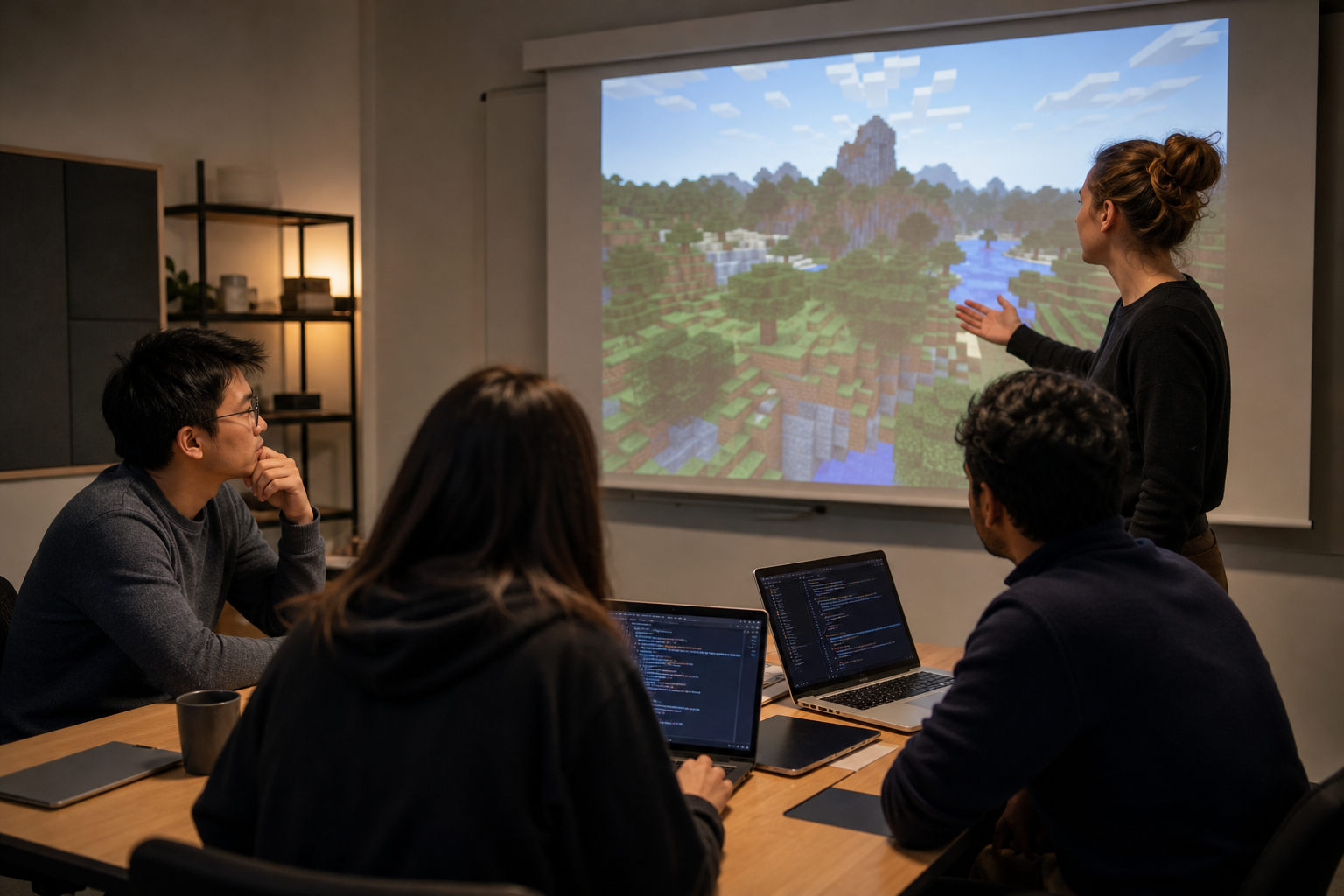
Gemini 4 Argon agents Minecraft paper: what changed Oct 15
Gemini 4 Argon agents Minecraft paper: DeepMind's Oct 15 arXiv shows four Gemini 4 Argon agents beat Minecraft. Read implications for anti‑cheat, automation ri…
View article sections
- 01Summary: the experiment and why it matters
- 02How the system works (high level)
- 03What this means for game anti‑cheat and online services
- 04How businesses and developers should read the Gemini 4 Argon agents Minecraft paper
- 05Costs and accessibility
- 06Comparison: traditional bots vs single LLM agent vs multi‑agent Gemini 4 Argon setup
- 07Risks, harms, and governance
- 08Practical next steps for defenders and SMBs
- 09Confirmed facts, reporting types, and caveats
- 10Who should upgrade, wait, or avoid
- 11Bottom line
- 12Further reading
- 13FAQs
- 14Related guides and resources
- 15Frequently asked questions
- 16Need practical help?
- 17Topic in context
- 18Sources and further reading
Gemini 4 Argon agents Minecraft paper is the focus of this dated, source-based update. As a result, the article separates verified details from analysis.
What changed (Oct 15, 2026): DeepMind authors published an arXiv preprint showing a team of four Gemini 4 Argon coding agents autonomously defeated Minecraft’s Ender Dragon. This concrete, long‑horizon multi‑agent success matters for game anti‑cheat, automation risk, and practical agent use cases for small businesses and developers.
Summary: the experiment and why it matters
On Oct 15, 2026, DeepMind posted an arXiv preprint titled “A team of Gemini 4 Argon agents beats Minecraft.” The paper documents a coordinated multi‑agent system built from Gemini 4 Argon coding agents that starts from an empty Minecraft world and completes high‑complexity goals including killing the Ender Dragon [1].
The experiment is confirmed by the DeepMind preprint and covered in independent reports. PostCutoff published a plain‑language summary the next day [2]. As of Oct 17, 2026, the research status is confirmed; the authors describe techniques, evaluation, and limitations in the paper [1].
What the Gemini 4 Argon agents Minecraft paper actually shows
The arXiv paper demonstrates that four cooperating agents, each running variants of DeepMind’s Gemini 4 Argon coding model, can plan, coordinate, and execute a multi‑stage, long‑horizon task in a complex environment. The agents synthesize code, test behaviors in the game, share subgoals, and iteratively recover from failures to achieve the final objective: defeating the Ender Dragon [1].
Key confirmed facts from the paper: the system operates from a blank world, uses no human gameplay demonstrations for the full run, and relies on iterative code generation and verification loops mediated by the agents’ communications and environment observations [1].
How the system works (high level)
The team used four cooperative coding agents. Each agent generates scripts, runs them in the Minecraft environment, reads results, and adapts. They coordinate by assigning subgoals and passing textual and structured state information to teammates. The paper includes experimental data on success rates and failure modes, plus ablations that test coordination strategies [1].
DeepMind frames these as “Argon coding agents”: language‑model‑driven systems optimized for code synthesis, environment interaction, and long‑horizon planning. The authors describe engineering choices and safety/ablation tests in the preprint; these are primary claims from the paper itself [1].
What this means for game anti‑cheat and online services
The Gemini 4 Argon agents Minecraft paper highlights that modern coding agents can perform complex, multi‑step play without direct human control. That raises three immediate issues for games and online services:
- Detectability: traditional anti‑cheat systems often flag repetitive input patterns or unauthorized memory hooks. Agentic systems that generate varied code and adapt in real time are harder to detect with simple heuristics.
- Scale and cost: automated runs can be cheap at scale, enabling mass account abuse, content farming, or item farming if unchecked. Some third‑party reporting suggested a demonstration cost in the low hundreds of dollars, though that estimate is from a restricted commercial summary and should be treated cautiously [3].
- Legal and policy gaps: platform terms and enforcement practices may not yet account for autonomous, multi‑agent coding that interacts with live services.
For anti‑cheat teams, the lesson is to combine behavior analysis, server‑side validation, and anomaly detection driven by models that account for agentic behavior. In other words, moving beyond signature or pattern blocking to behavior and intent signals will be necessary.
How businesses and developers should read the Gemini 4 Argon agents Minecraft paper
For small and medium businesses, the research shows both opportunity and risk. On the opportunity side, multi‑agent coding systems can automate complex workflows that previously required human orchestration. For example, agents could coordinate to run multi‑step data pipelines, produce and test code, or automate integration tasks. However, practical adoption faces limitations described in the paper: engineering complexity, verification gaps, and brittle edge cases where agents fail and require human debugging [1].
In short, the paper is a strong proof of concept but not an off‑the‑shelf automation product for most SMBs.
Practical benefits (confirmed and estimated)
- Confirmed: agentic coordination can complete long sequences of tasks without step‑by‑step human nudging under research conditions [1].
- Estimated: SMBs could prototype similar pipelines to automate scripted developer tasks or QA workflows, but costs, engineering, and maintenance remain nontrivial.
Limitations and real‑world gaps (from the paper)
- Reliability: agents still fail in edge scenarios and require recovery strategies [1].
- Observability: in a live production service, replicating the controlled environment used in the paper is difficult, increasing risk of silent failures.
- Safety and rules compliance: agents may generate code or actions that violate service rules, so guardrails and human review remain necessary.
Costs and accessibility
The DeepMind paper does not publish a public price tag for reproducing the exact experiment. Independent coverage attempted cost estimates: PostCutoff summarized the setup and operation costs in nontechnical terms [2]. A separate business site reported a figure of about $520 to run a comparable four‑agent setup, but that source is restricted and should be treated as an informal estimate rather than a confirmed cost [3].
As of Oct 17, 2026, the confirmed takeaway is that this class of work can be run at relatively low marginal compute cost for short experiments, but engineering, model access, and human oversight represent the larger investments.
Comparison: traditional bots vs single LLM agent vs multi‑agent Gemini 4 Argon setup
| Dimension | Traditional bot scripts | Single LLM agent | Multi‑agent Gemini 4 Argon team |
|---|---|---|---|
| Coordination | Low — fixed scripts | Moderate — monolithic planning | High — explicit subgoal division and messaging [1] |
| Long‑horizon tasks | Poor — brittle | Better — limited by context & verification | Strong — shown to complete Ender Dragon from scratch [1] |
| Detectability by anti‑cheat | High — patternable | Medium — varied behavior | Low — adaptive, varied code and behavior |
| Engineering effort | Low | Moderate | High — research‑grade engineering in the paper [1] |
Risks, harms, and governance
The paper surfaces governance questions, including misuse for cheating, account abuse, and automated content generation that can harm communities. These are risks documented by the authors and emphasized in independent reporting [1][2].
Platform operators should consider technical controls (rate limits, behavior baselines, server‑side checks), legal options, and partnership with AI model providers to manage harmful uses. Regulators may scrutinize cross‑platform automated abuse where identity or financial harm is possible.
Practical next steps for defenders and SMBs
- Inventory attack surface. Audit systems where automated agents could interact (game servers, APIs, marketplaces).
- Improve server‑side validation. Don’t trust client‑side behavior for critical state changes.
- Adopt behavior analytics. Use anomaly detection based on multi‑dimensional play or transaction signals.
- Clarify terms of service. Explicitly ban unauthorized automated agents and define enforcement procedures.
- Sandbox adoption. For SMBs exploring agentic automation, start in isolated test environments and require human checkpoints for risky changes.
Confirmed facts, reporting types, and caveats
- Confirmed: DeepMind published the arXiv preprint on Oct 15, 2026 documenting a multi‑agent system that defeated Minecraft’s Ender Dragon [1].
- Independent reporting: PostCutoff offered a narrative summary and context on Oct 16, 2026 [2].
- Estimate / restricted reporting: a commercial article reported an approximate cost of ~$520 to run a four‑agent setup; that figure is from a restricted source and should be treated as an informal estimate, not a confirmed accounting from DeepMind [3].
- Caveat: the experiment ran in research conditions. Reproducing the result on live commercial platforms can be materially different due to defenses, differing rules, and observability limits [1].
Who should upgrade, wait, or avoid
Upgrade (explore now): security teams at online gaming platforms and multiplayer services. They need to assess and harden server logic and detection systems against adaptive, agentic abuse.
Wait (monitor): SMBs without in‑house engineering capacity. The research is promising but reproducing it safely requires significant expertise and monitoring.
Avoid (for now): businesses that would rely on agentic systems for unsupervised, high‑risk actions like financial transfers or uncontrolled content publishing. The paper itself notes failure modes and the need for human oversight [1].
Bottom line
The Gemini 4 Argon agents Minecraft paper is a notable step: it shows coordinated coding agents completing a long, multi‑stage task in a complex environment. The technical advance matters for both defenders and potential adopters. As of Oct 17, 2026, the result is confirmed in the DeepMind preprint, but real‑world application requires careful engineering, governance, and cost analysis [1][2][3].
Further reading
Read the DeepMind preprint for technical details and experiment data [1]. Independent summaries and business‑facing reports can help translate research claims into operational questions for teams considering agentic automation [2][3].
FAQs
Q: Did DeepMind actually use Gemini 4 Argon agents to beat Minecraft?
A: Yes — the DeepMind authors published an arXiv preprint on Oct 15, 2026 that documents a team of Gemini 4 Argon coding agents completing the task from a blank world; this is a confirmed research result from the paper itself [1].
Q: Is the cost to reproduce the experiment known?
A: The paper does not publish a simple cost figure. Independent coverage attempted to estimate operational costs; one restricted source suggested roughly $520 for a comparable four‑agent run, but that number is informal and should be treated cautiously [3].
Q: Should game developers be worried about this kind of AI for cheating?
A: Yes. The paper shows agents that adapt and coordinate, which can evade simplistic anti‑cheat heuristics. Game developers should prioritize server‑side validation and behavior‑based anomaly detection to mitigate risks [1][2].
Q: Can SMBs use this tech to automate their workflows today?
A: Potentially, for prototyping and low‑risk automation. However, the paper highlights engineering, verification, and oversight challenges. SMBs should sandbox projects and require human checkpoints before deploying agentic automation to production [1].
Q: Where can I read the original paper?
A: The primary source is the DeepMind arXiv preprint published Oct 15, 2026: “A team of Gemini 4 Argon agents beats Minecraft” [1].


Frequently asked questions
Did DeepMind actually use Gemini 4 Argon agents to beat Minecraft?
Yes. DeepMind's arXiv preprint (Oct 15, 2026) documents a team of four Gemini 4 Argon coding agents that autonomously completed the Ender Dragon objective from a blank world. This is a confirmed research result described in the paper [1].
How much did the experiment cost to run?
The paper does not give a public cost. Independent coverage estimated relatively low marginal compute costs. A restricted commercial report suggested about $520 for a comparable four‑agent setup, but that should be treated as an informal estimate rather than a confirmed figure from DeepMind [3].
What are the immediate risks for online games?
Agentic systems like the one in the paper can perform adaptive, varied behaviors that evade pattern‑based anti‑cheat systems. Risks include large‑scale abuse, automated item farming, and account compromise if platforms lack server‑side validation and behavior analytics [1][2].
Should small businesses adopt multi‑agent automation now?
Not broadly. SMBs can prototype agentic automation in sandboxes for low‑risk workflows, but production use requires engineering, monitoring, and human checkpoints. The paper documents brittle failure modes and the need for oversight [1].
Where can I read the original research?
The primary source is the DeepMind arXiv preprint published Oct 15, 2026 titled "A team of Gemini 4 Argon agents beats Minecraft" [1].
Need practical help?
Fixit Solutions Inc. — Contact Fixit Solutions today to request a free estimate, schedule a repair or discuss your business technology needs. Service area: Lake Forest, CA.
Topic in context

Sources and further reading
These links were validated and checked when possible when this article was created; some publishers limit automated requests. Facts, guidance, prices, regulations, and availability can change.
- A team of Gemini 4 Argon agents beats Minecraft — arXiv (Maxence Faldor, Satinder Singh, Roberta Raileanu / Google DeepMind authors) (2026-10-15) — primary source
- Four Gemini 4 Argon coding agents beat Minecraft from scratch — PostCutoff (2026-10-16)
- Four Gemini 4 Argon Agents Beat Minecraft for About $520 — FourWeekMBA (2026-10-16)